
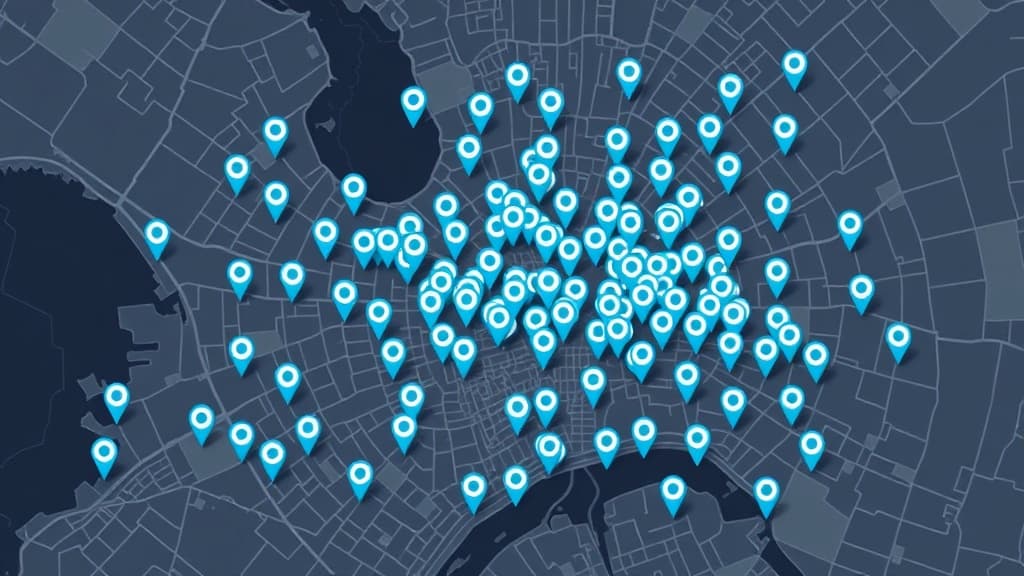
Managing SEO for a single location is straightforward. Managing it for ten, fifty, or five hundred locations introduces an entirely different set of problems, duplicate content, inconsistent NAP data, competing listings, and content that looks templated to both users and Google. Multi-location SEO is the discipline of making every one of those locations individually discoverable, individually authoritative, and individually competitive in its own local market.
The businesses that get this right don't just rank, they dominate. A properly executed multi-location strategy puts each storefront into the Google Map Pack for its target city, builds topical authority at the brand level, and creates a compounding content moat that single-location competitors can't match.
The biggest mistake multi-location businesses make is treating all locations identically. Each location competes in a different market with different competitors, different search volumes, and different customer expectations. Cookie-cutter approaches get cookie-cutter results.
Why Multi-Location SEO Is Different
Single-location local SEO focuses on one Google Business Profile, one set of citations, and one location page. Multi-location SEO requires a scalable system that maintains quality and uniqueness across every location while building brand-level authority. The challenge isn't doing the work once, it's doing it consistently at scale without creating the kind of thin, duplicated content that triggers algorithmic penalties.
Google evaluates each location independently. Your Dallas storefront competes against other Dallas businesses, not against your Houston location. That means each location needs its own Google Business Profile, its own location page with unique content, its own local citations, and its own review generation strategy. The brand provides top-level authority, but the local signals must be genuinely local.
Building Scalable Location Pages
Location pages are the foundation of multi-location SEO. Each page should target the primary service-plus-city keyword (e.g., "plumber in Austin") and include genuinely unique content about that market. This isn't about swapping city names in a template, it's about creating pages that reflect the reality of doing business in that specific area.
What Every Location Page Needs
- Unique H1 targeting the primary local keyword for that market
- Location-specific content: references to neighborhoods, landmarks, local events, and community involvement
- Embedded Google Map showing the exact business location
- NAP (Name, Address, Phone) data matching the Google Business Profile exactly
- Location-specific reviews or testimonials from customers in that area
- Structured data markup using LocalBusiness schema with unique @id for each location
- Internal links to the brand's service pages and to nearby location pages
- Clear calls to action with location-specific phone numbers or booking links
- Photos of the actual location, team members, and completed work in that area
- Operating hours specific to that location, matching GBP hours exactly
URL Structure for Multi-Location Sites
Your URL architecture should make the hierarchy clear to both users and search engines. The most effective pattern is /locations/city-name/ for location pages, with service-specific location pages nested as /locations/city-name/service-name/. Google treats subdomains and subdirectories largely the same for indexing, but subdirectories under one root domain are dramatically easier to operate at scale: one analytics property, simpler internal linking, consolidated CMS, and a single canonical brand entity for Google to associate signals with.
| URL Pattern | Use Case | SEO Impact |
|---|---|---|
| /locations/dallas/ | Location hub page | Strong, consolidates authority for that city |
| /locations/dallas/plumbing/ | Service + location page | Strong, targets specific commercial intent queries |
| dallas.yourbrand.com | Subdomain per city | Workable for SEO, but harder to operate (separate analytics, more complex internal linking, fragmented CMS) |
| /locations/dallas-tx-plumber/ | Keyword-stuffed URL | Risky, looks manipulative to both users and algorithms |
Citation Management at Scale
Citation consistency is critical for every location, and it becomes exponentially harder as you add locations. A single inconsistency, a suite number formatted differently, a phone number with dashes instead of dots, can suppress a location's visibility in the Map Pack. At scale, you need a citation management platform that can monitor and correct listings across dozens of directories for every location simultaneously.
Focus citation building efforts on the directories that actually move the needle: Google Business Profile, Apple Maps, Bing Places, Yelp, Facebook, and the top industry-specific directories for your vertical. A local SEO agency that specializes in multi-location businesses will have systems for this. If you're doing it in-house, build a spreadsheet that tracks every listing URL for every location and audit it quarterly.
Content Strategy for Multi-Location Brands
The biggest content challenge for multi-location businesses is avoiding thin, duplicated pages. Google's helpful content system is specifically designed to identify and demote pages that exist solely for SEO purposes without providing genuine value. Your content strategy needs to produce location pages that are genuinely useful to someone in that market, not just SEO landing pages with swapped city names.
Content Differentiation Tactics
- Interview local team members and incorporate their expertise into location-specific content
- Reference local regulations, permit requirements, or market conditions unique to each area
- Create case studies featuring work completed in each market
- Build neighborhood guides or area-specific resource pages that demonstrate genuine local knowledge
- Develop location-specific FAQ sections based on actual questions received from customers in that area
- Publish local SEO reports showing market-specific insights and trends
Review Strategy Across Locations
Reviews are the most powerful local ranking factor, and they need to be managed per-location. Each Google Business Profile should have its own review generation workflow. The most effective approach is to make review requests part of the service delivery process, automated follow-up emails or SMS messages sent after service completion, with a direct link to the specific location's GBP review page.
Don't funnel all reviews to a single corporate profile. Google rewards locations that earn their own reviews from customers who actually visited or were served by that specific location. A location with 50 genuine reviews will consistently outrank a location with 5 reviews, even if the brand overall has thousands. For review response best practices, see our GBP optimization guide.
Measuring Multi-Location Performance
Tracking performance across multiple locations requires dashboards that can surface location-level metrics without drowning you in data. The key metrics for each location are: Map Pack ranking for primary keywords, GBP impressions and actions (calls, direction requests, website clicks), organic traffic to the location page, and conversion rate from location page visitors to leads. Local SEO reporting should make it easy to spot underperforming locations and prioritize your efforts.
A common pattern: 20% of your locations will drive 80% of your leads. Don't spread your SEO budget equally across all locations. Identify the high-opportunity markets and invest disproportionately there. Use local SEO pricing benchmarks to allocate budget intelligently.
Common Multi-Location SEO Mistakes
- Using the same content across location pages with only the city name swapped
- Creating a single GBP listing for a brand instead of individual listings per location
- Neglecting locations that aren't currently performing, rather than investigating why
- Failing to build location-specific backlinks from local organizations, chambers of commerce, and community partners
- Not implementing entity SEO to help Google understand the relationship between parent brand and individual locations
- Ignoring service area business considerations for locations that also serve surrounding areas
Frequently Asked Questions
How many location pages can a website have before Google considers it spammy?
There's no hard limit. Google cares about quality, not quantity. If every location page provides genuine value to users in that market, unique content, real reviews, accurate information, you can have hundreds of location pages. The problems start when pages are thin, duplicated, or exist solely for keyword targeting.
Should I use separate domains for each location?
No. Separate domains fragment your authority and multiply your management overhead. Use a single domain with a clear /locations/city-name/ URL structure. This consolidates all your backlinks and domain authority under one roof.
How do I handle locations that are close together?
Nearby locations (e.g., two stores 10 miles apart) should each have their own GBP listing and location page. The content should differentiate by referencing specific neighborhoods, cross streets, and communities each location serves. Avoid having both pages target identical keywords, differentiate by neighborhood or sub-market.
What's the most important ranking factor for multi-location SEO?
Google Business Profile optimization and reviews. Each location needs a fully completed, verified GBP with consistent NAP data, relevant categories, regular posts, and a steady flow of genuine customer reviews. Everything else amplifies GBP signals, but without a strong GBP foundation, nothing else matters.
How long does it take to rank a new location?
A new location with an established brand typically takes 3-6 months to gain meaningful Map Pack visibility. New brands without existing authority may take 6-12 months. The timeline depends on market competition, review velocity, and the strength of your location page content and citations.

Written by
Jason JacksonChief Operating Officer, Locafy Limited
COO at Locafy (Nasdaq: LCFY). Builds and operates AEO systems for local businesses. Founded Growth Pro Agency before joining Locafy via acquisition.